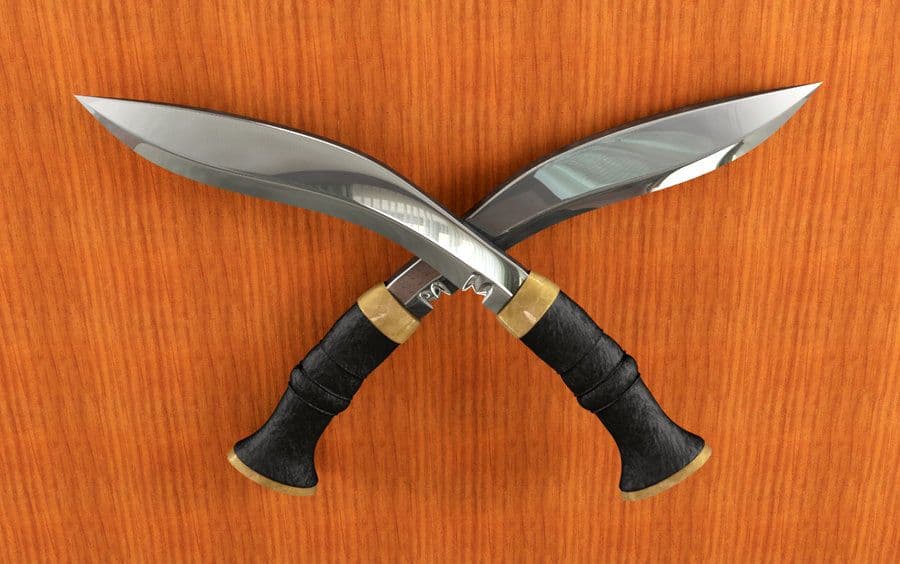
History of Khukuri in Nepal | Gurkha Legacy & Legendary Blade
2025-12-23
14 min read
The exact origins of the Khukuri are hidden in the mists of Himalayan history, with multiple theories vying for historical accuracy. Most scholars agree that this iconic blade carries a legacy of at least 2,500 years. What is certain, however, is that its distinctive curved design has been deeply intertwined with Nepal and its people for centuries, and possibly much longer.
Theories of Origin of the Khukuri Blade
The Ancient Warfare Theory
Some historians trace the Khukuri's design back to the ancient Greek kopis or the Macedonian makhairak, curved swords used by Alexander the Great's armies. When Alexander's campaign reached the edges of the Indian subcontinent around 326 BCE, the theory suggests that blade designs influenced local weapon-making traditions. However, this connection remains speculative and lacks definitive archaeological evidence.
The Domestic Evolution Theory
A more widely accepted theory proposes that the Khukuri evolved organically from agricultural tools used by Nepal's hill communities. The curved blade design is naturally efficient for cutting, clearing vegetation, and processing meat, tasks central to mountain farming life. Over generations, this practical tool was refined into a formidable weapon when needed.
The Malla Period Evidence
The earliest confirmed references to Khukuri-like blades appear during Nepal's Malla period (12th-18th centuries). Historical texts and artwork from this era depict curved blades being carried by soldiers and used in ceremonial contexts. The National Museum of Nepal in Kathmandu houses several antique blades dating back to this period, though precise dating remains challenging.
The Name: Khukuri, Kukri, or Khukri?
The weapon's name itself varies in spelling and pronunciation:
-
Khukuri: The most phonetically accurate transliteration from Nepali (खुकुरी)
-
Kukri: British anglicization from the colonial period
-
Khukri: Alternative spelling commonly used
All refer to the same blade, though "Khukuri" is considered most authentic by Nepali speakers. The name likely derives from "Khukura," the Nepali word for a curved shape.
The Rise of the Gorkha Kingdom
The Khukuri's transformation from a practical tool to a legendary weapon coincides with the unification of Nepal under King Prithvi Narayan Shah in the 18th century. The Shah dynasty originated from Gorkha (also spelled Gurkha), a small hill kingdom west of Kathmandu.
Unification of Nepal (1743-1775)
Prithvi Narayan Shah embarked on an ambitious campaign to unite the fragmented kingdoms of the Kathmandu Valley and surrounding regions. His soldiers, tough mountain fighters from various ethnic groups, including Gurungs, Magars, Rais, and Limbus, carried the Khukuri as their primary weapon alongside other arms.
The difficult terrain of Nepal's mountains made the Khukuri ideal:
-
Lightweight enough for long mountain marches
-
Versatile for both combat and camp duties
-
Effective in close-quarters fighting on narrow mountain paths
-
Durable with simple maintenance requirements
By 1768, the Gorkha army had conquered the Kathmandu Valley, and by 1775, Nepal had been largely unified. The fighting reputation of these Gorkha warriors and their distinctive blades had begun to spread.
The Anglo-Nepalese War (1814-1816)
The Khukuri and its wielders gained international recognition during the Anglo-Nepalese War, a conflict that would forge the legendary reputation of the Gurkha soldier.
Background of Conflict
As the British East India Company expanded across the Indian subcontinent, tensions grew with the expanding Nepalese kingdom. Border disputes in the Terai region eventually erupted into full-scale war in 1814.
The Battle of Nalapani
One of the war's most famous engagements occurred at Nalapani Fort in present-day Uttarakhand, India. A small garrison of about 600 Nepalese soldiers under Balabhadra Kunwar held out against a British force estimated at 3,500-5,000 troops.
The British forces, accustomed to relatively easy victories across India, faced unexpectedly fierce resistance. British accounts from the siege describe the terrifying effectiveness of Khukuri-wielding Nepalese soldiers in close combat. One British officer wrote:
"They fought us in fair conflict and proved themselves to be brave, athletic soldiers. The Gurkhas fought till they were killed or escaped. The wounded made no supplication, no complaint, only grimly awaited the next blow, or if able to reach their knives, they would rather inflict self-harm than fall into enemy hands."
Though the fort eventually fell due to water shortages after a month-long siege, the defenders' courage made a profound impression on the British.
Mutual Respect and Treaty
The war ended in 1816 with the Treaty of Sugauli, where Nepal ceded some territory but retained its independence—one of the few regions in South Asia to avoid British colonization. More significantly, the British were so impressed by the fighting qualities of the Gorkha soldiers that they immediately began recruiting them into the British Indian Army.
A British officer famously wrote after the war: "If I could have your Gurkha soldiers, I would cut through Asia."
The Gurkha Legacy: Military Service Worldwide: Recognition Through Global Conflict
The Anglo-Nepalese War marked the beginning of an extraordinary military tradition that continues to this day.
Formation of Gurkha Regiments (1815)
The British began recruiting Nepali soldiers immediately after the war, forming the first Gurkha units in 1815. These would grow into multiple regiments that served in conflicts across the globe:
19th Century Service:
-
Indian Rebellion of 1857 (Sepoy Mutiny)
-
Second Anglo-Afghan War (1878-1880)
-
Various frontier campaigns in India
World War I (1914-1918)
Over 200,000 Gurkha soldiers served in World War I, fighting on multiple fronts:
Key Contributions:
-
Western Front: Trench warfare in France and Belgium
-
Middle East: Gallipoli campaign, Mesopotamia, Palestine
-
Africa: East Africa campaign
The Khukuri in Trench Warfare
While modern warfare had evolved to artillery and machine guns, the Khukuri proved devastatingly effective in trench raids and close combat. British military records document numerous instances of Gurkha soldiers using a Khukuri in night raids, where the blade's silence was advantageous over firearms.
One famous incident from 1915 involved a young Gurkha rifleman who, when his ammunition ran out, defended his position against multiple German soldiers using only his Khukuri. He survived the war and the incident became part of Gurkha regimental lore.
Recognition:
-
13 Victoria Crosses awarded to Gurkha soldiers in WWI
-
Over 20,000 Gurkha casualties
-
The reputation of the Khukuri spread throughout European armies
World War II (1939-1945)
World War II saw even greater Gurkha participation, with over 250,000 serving in multiple theaters:
Major Campaigns:
-
Burma Campaign: Jungle warfare against Japanese forces
-
North Africa: Desert warfare in Libya and Egypt
-
Italy: Mountain warfare in the Italian campaign
-
Southeast Asia: Malaya, Singapore, Borneo
The Burma Campaign and the Khukuri
The Burma campaign showcased the Khukuri's effectiveness in jungle warfare. The dense vegetation and close-quarters combat suited the blade perfectly. Japanese soldiers reportedly feared encountering Gurkhas in the jungle, where the Khukuri was more effective than longer swords.
One documented incident from 1944 involved Rifleman Ganju Lama, who single-handedly destroyed two Japanese tanks with grenades, then defended his position with his Khukuri when Japanese infantry counterattacked. He was awarded the Victoria Cross for this action.
The Legend Grows
Stories, some documented, others likely embellished, spread about the Khukuri's effectiveness:
-
A saying developed: "A Gurkha never sheaths his Khukuri without drawing blood."
-
Tales of single Gurkhas defeating multiple enemies in close combat
-
The psychological impact of facing Khukuri-wielding Gurkhas
Recognition:
-
26 Victoria Crosses awarded to Gurkha soldiers in WWII
-
Over 30,000 Gurkha casualties
-
The Khukuri became internationally recognized
Post-WWII Service
After India's independence in 1947, Gurkha regiments were divided:
British Army:
-
Four Gurkha regiments transferred to British service
-
Continue to serve today as the Royal Gurkha Rifles
-
Participated in: Malayan Emergency, Falklands War, Afghanistan, Iraq
Indian Army:
-
Six Gurkha regiments remained with Indian Army
-
Participate in all Indian military operations
-
Largest contingent of Gurkha soldiers worldwide
Nepali Army:
-
Nepal's own army maintains Gurkha traditions
-
Khukuri remains standard military equipment
-
Participates in UN peacekeeping missions
Modern Military Use
Today, the Khukuri remains in active military service:
Current Usage:
-
Standard issue: All Gurkha soldiers receive a service Khukuri
-
Ceremonial role: Used in military ceremonies and parades
-
Practical tool: Still carried for utility purposes
-
Special forces: Some non-Gurkha special forces units have adopted the Khukuri
-
Combat use: Khukuri is used in close combat
The Khukuri in Nepali Society
While the Khukuri gained fame through military service, it has always been fundamental to Nepali civilian life.
Traditional Household Tool
In rural Nepal, the Khukuri serves numerous practical purposes:
Agricultural Uses:
-
Clearing brush and vegetation
-
Harvesting crops
-
Cutting fodder for livestock
-
Processing timber
Household Uses:
-
Food preparation (especially meat processing)
-
Firewood chopping
-
Bamboo splitting for construction
-
General utility cutting tasks
Traditional Saying: "A home without a Khukuri is like a tree without roots", highlighting its essential nature in Nepali life.
Religious and Ceremonial Significance
Dashain Festival
The Khukuri plays a central role in Dashain, Nepal's most important Hindu festival:
-
Used for sacrificial rituals (particularly buffalo sacrifice)
-
Blessed by priests during ceremonies
-
Considered spiritually powerful
-
Traditional cleaning and sharpening before the festival
Wedding Ceremonies
In many Nepali communities, the Khukuri features in traditional weddings:
-
The groom may carry a ceremonial Khukuri
-
Symbol of the groom's ability to protect his family
-
Part of the traditional wedding dress in some ethnic groups
Coming of Age
In Gurkha and other communities, receiving a Khukuri marks the transition to adulthood:
-
Young men traditionally receive their first Khukuri around age 16
-
Represents responsibility and capability
-
Often passed down through generations as family heirlooms
Cultural Symbolism
The Khukuri represents several important values in Nepali culture:
Bravery: Associated with courage and martial prowess. Self-reliance: A tool for independence and survival.
National identity: a symbol of Nepal itself.
Craftsmanship: Represents traditional artisan skills.
Heritage: Connects the present to historical traditions
The Khukuri as National Symbol
The Khukuri appears prominently in Nepali national iconography:
National Emblems:
-
Featured on Nepal Army insignia
-
Appears on police and military badges
-
Used in government seals and official documents
-
Part of the Nepalese Rupee coin designs
Cultural Representation:
-
Museums worldwide display antique Khukuri
-
Featured in Nepali art and literature
-
Subject of numerous books and documentaries
-
Symbol of Nepal in international contexts
Evolution Through the Centuries
The Khukuri has evolved while maintaining core characteristics:
Ancient Period (Pre-1700s):
-
Primarily a utility tool with combat capability
-
Regional variations in design
-
Handcrafted by local blacksmiths
Unification Era (1700s-1800s):
-
Standardization begins with military use
-
Improved metallurgy techniques
-
Growing reputation through Gorkha conquests
Colonial Period (1815-1947):
-
British military specifications influence design
-
Service patterns emerge
-
International recognition grows
Modern Era (1947-Present):
-
Mass production alongside traditional crafting
-
Tourist souvenir industry develops
-
Global collector market emerges
-
Modern materials and designs appear
The Global Spread of Khukuri Appreciation
Today, the Khukuri enjoys worldwide recognition beyond military circles:
Outdoor Enthusiasts:
-
Bushcraft and survival communities
-
Camping and hiking gear
-
Wilderness survival tools
Martial Arts:
-
Filipino martial arts incorporate Khukuri techniques
-
Various knife-fighting systems study the blade
-
Training weapons and practice pieces
Collectors:
-
Antique military Khukuri commands high prices
-
Custom makers create artistic pieces
-
Historical collections in museums worldwide
Popular Culture:
-
Featured in numerous films and television shows
-
Video games include Khukuri as weapon choice
-
Books and documentaries explore its history
Preservation of Tradition
Despite modernization, traditional Khukuri making continues:
Artisan Communities:
-
Bhojpur District maintains traditional forging methods
-
Master craftsmen (Kami) pass skills to new generations
-
Government initiatives support traditional crafts
-
Tourism provides income for traditional artisans
Cultural Organizations:
-
Gurkha Museums in the UK and Nepal preserve history
-
Military museums display historical pieces
-
Cultural centers teach traditional forging techniques
-
Academic research documents traditional methods
The Khukuri Today
In contemporary Nepal and worldwide, the Khukuri maintains its significance:
Continued Military Use: Still standard issue for Gurkha soldiers.
Cultural Icon: Represents Nepali identity globally
Practical Tool: Remains essential in rural Nepal
Collector's Item: Antique and custom pieces are highly valued.
Commercial Product: Important export for Nepali artisans
Symbol of Excellence: Associated with Gurkha courage and skill
The Khukuri's journey from a practical tool in the Himalayan hills to a globally recognized symbol of courage is remarkable. Its history is inseparable from the story of Nepal itself, from the unification of the nation to the legendary reputation of Gurkha soldiers who carried it into battles across the world.
Unlike many historical weapons that have become museum pieces, the Khukuri remains vibrantly alive in daily use, military service, and cultural practice. It continues to be forged using techniques passed down through generations, carried with pride by Gurkha soldiers, and used daily in Nepali homes.
The Khukuri represents not just a blade, but a living connection to history, culture, and tradition that continues to evolve while honoring its ancient roots.